
Why Prayer Times Change Daily

Why Prayer Times Change Daily (And Why That’s Normal)
If you’ve ever checked a prayer schedule and noticed that Fajr, Maghrib, or Isha moved by a minute or two, you’re seeing a built-in feature, not a mistake. Prayer times change daily because they follow the sun’s position, not a fixed clock setting.
In Islamic practice, each salah has a time window tied to a visible change in the sky. Since the sun’s rise, peak, and set don’t happen at the exact same minute every day, the schedule shifts with them.
This article explains the simple astronomy behind those daily changes, why the pattern looks different by season and location, and why apps can produce precise local timetables. Solar time means time measured by the sun’s position in your local sky.
The sun sets the schedule, so the schedule moves
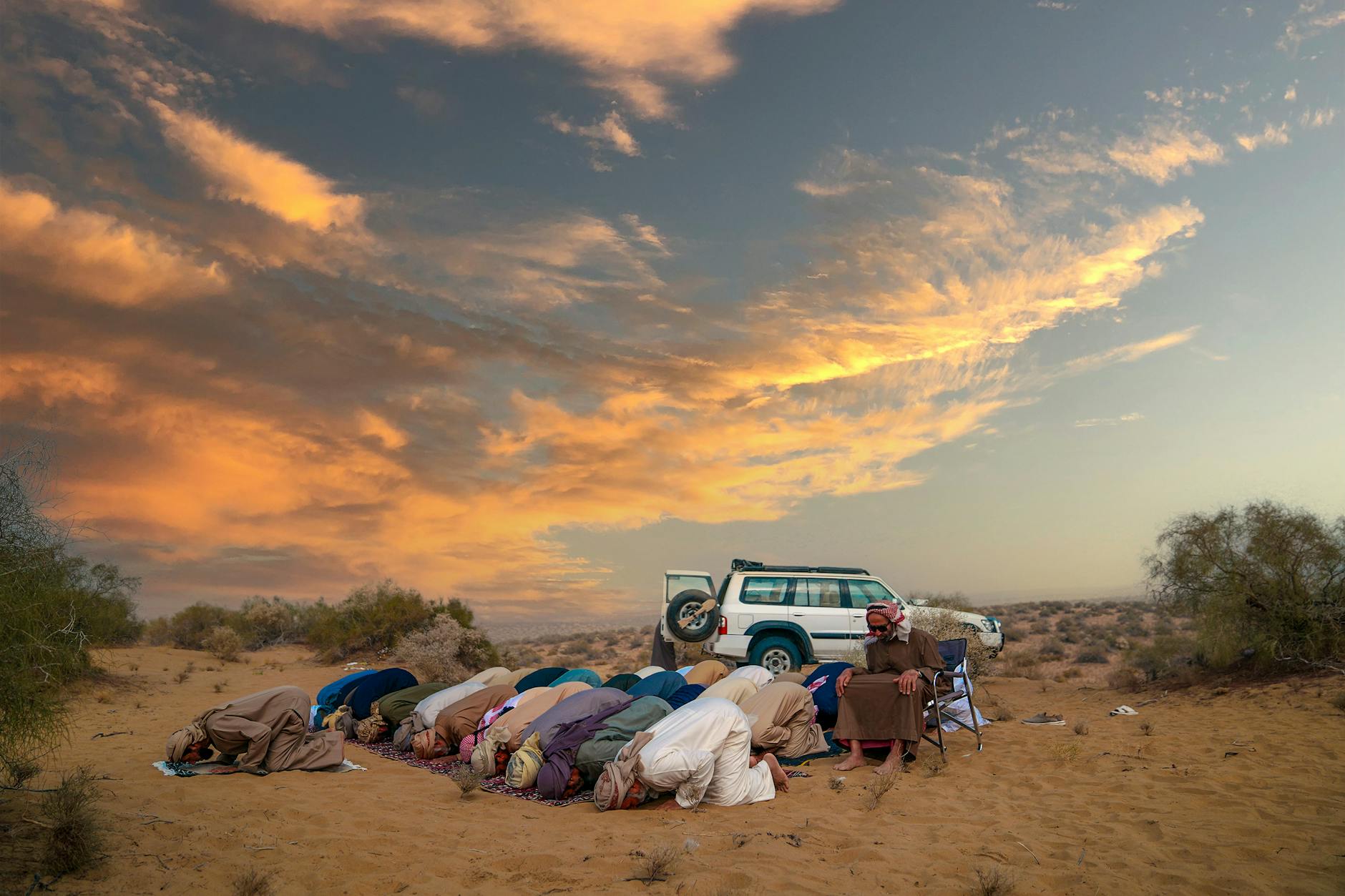
Photo by Tauseef Kazmi
Islamic prayer times are defined by solar markers. That single fact explains most daily change. A clock is a human tool, built around time zones and neat hours. The sky doesn’t follow those rules.
Think of the day as a moving track. The sun slides along it a little differently each day. When the marker moves, the prayer time linked to it moves too. Some days the change is small. In other parts of the year, it speeds up.
If you compare today’s and tomorrow’s schedule, you might see only a one-minute shift. Over weeks, those minutes add up. That’s why a printed calendar is made for a specific month and place, and why apps update daily.
For a concise summary of how the main times are defined, see the reference page on Salah time definitions. The details below use the same idea: each prayer tracks a real event in the sun’s path.
What each prayer time is based on in the sky
Each salah begins when a recognizable solar condition starts. These are not abstract concepts. They map to what the sun is doing relative to your horizon.
- Fajr begins at dawn, when early morning light spreads across the horizon (astronomers call this twilight).
- Dhuhr starts after the sun reaches its highest point for that day, often called solar noon.
- Asr depends on shadow length, which changes as the sun lowers. Schools of law use different shadow rules (commonly described as Shafiʻi and Hanafi methods), but both rely on the same physical cue: the shadow grows as the sun’s angle falls.
- Maghrib begins at sunset, when the sun disappears below the horizon.
- Isha begins when evening twilight ends and the sky becomes properly dark.
Because these are sun-based, they must change when sunrise, solar noon, and sunset change. Even if your clock looks steady, the sun’s daily timing is not perfectly steady.
Why tomorrow’s sunrise isn’t at the same minute as today’s
Earth turns once every 24 hours, but it also moves along its orbit around the sun. That combination matters.
If Earth only rotated and did not orbit, the sun would cross your local sky at the same clock times each day. But Earth advances in its orbit daily, so the sun’s apparent position at a given clock minute shifts. The change is small, but it’s continuous. That is why sunrise and sunset creep earlier or later across the calendar.
There’s also a smaller correction that affects the “clock time” of solar noon. It’s called the equation of time. In plain terms, solar noon is not always exactly at 12:00 pm on a clock.
Two reasons cause that mismatch:
- Earth’s orbit is not a perfect circle, so orbital speed changes during the year.
- Earth is tilted, so the sun’s apparent path isn’t uniform in clock time.
This can shift solar noon by minutes across the year. When solar noon shifts, Dhuhr shifts with it, and the other prayers get nudged as well. If you want a technical but readable breakdown of how calculations use these astronomical measures, the PrayTimes calculation documentation lays out the core ideas clearly.
Your city’s latitude and longitude change how fast the times shift
Daily change happens everywhere, but it doesn’t look the same everywhere. Location shapes both the baseline schedule and how quickly it drifts across the year.
Two cities on the same date can have very different prayer times because they don’t share the same local sky. The sun reaches their horizons at different moments, and it also follows a different arc depending on how far north or south they are.
If you’ve traveled, you’ve felt this directly. A routine that felt stable at home can compress or stretch in another region. The reason is simple: the Earth is round, tilted, and rotating.
Longitude explains why Dhuhr is earlier in the east and later in the west
Longitude is your east-west position. As Earth rotates, the sun appears to move across the sky. Because Earth rotates 360 degrees in 24 hours, that works out to about 15 degrees per hour. A practical rule is about 4 minutes per degree of longitude.
So if one city is far to the east of another, it reaches solar noon earlier. That means its Dhuhr will also be earlier, even on the same date. Time zones can hide this because they are a human choice. Two cities may share the same official time, but their solar time still differs.
A simple example: two cities separated by 15 degrees of longitude will have solar noon about an hour apart, even if their clocks are set similarly. This is why prayer schedules are local, not global, and why “one timetable fits all” doesn’t work outside a narrow region.
Latitude and seasons change day length, twilight, and Fajr and Isha
Latitude is your north-south position, and it strongly affects the sun’s path. Earth’s tilt is about 23.5 degrees. As Earth orbits the sun, that tilt changes how high the sun climbs in your sky at different times of year.
This creates the familiar pattern of seasons:
- In winter (in the Northern Hemisphere), the sun’s path is lower and shorter, so days are shorter.
- In summer, the sun’s path is higher and longer, so days are longer.
Prayer times follow that shift. Maghrib tracks sunset directly, so it moves earlier in winter and later in summer. Asr changes because shadows behave differently when the sun is low or high.
Fajr and Isha often show the biggest seasonal swing because they depend on twilight, not just sunrise and sunset. Twilight can be brief near the equator and very long in higher latitudes. That’s why near-equator locations tend to have more stable prayer schedules, while mid-latitude cities can see bigger seasonal movement.
At very high latitudes, unusual cases appear, such as extremely long twilight, or periods when the sky does not get fully dark. In such places, many prayer time providers apply adjustment rules based on scholarly guidance and practical need.
How prayer time tables and apps calculate daily changes
A prayer timetable turns sky conditions into clock times. The common approach is mathematical: it uses your coordinates, date, and standard solar equations to compute when the sun reaches specific angles relative to the horizon.
That is why apps can be precise for your street, while a generic calendar may be “close but not exact” if it was made for another neighborhood or a different elevation.
Modern apps also let you choose a calculation method used in your region, which reduces confusion when you compare different sources. The point isn’t that one schedule is “random,” it’s that methods choose slightly different parameters, then round times in slightly different ways.
Angles, methods, and why two calendars may differ by a few minutes
Many schedules define Fajr and Isha using twilight angles, often around 17 to 18 degrees below the horizon. Different organizations adopt different standards, and some use seasonal or regional adjustments. Asr can also differ depending on the juristic shadow rule used.
Other small factors can shift results by a minute or two:
- Altitude: higher places can see sunrise earlier and sunset later.
- Local horizon: mountains or buildings change what you observe, even if calculations assume a flat horizon.
- Rounding rules: some calendars round to the nearest minute, others always round up.
A helpful list of widely used standards is summarized in AlAdhan’s calculation methods. For a more research-oriented discussion that connects twilight and timing to real-world conditions, see the Cureus paper on astronomical considerations between Fajr and Isha.
Conclusion
Prayer times change daily for clear reasons: salah is tied to sun-based definitions, Earth rotates while orbiting the sun, Earth’s tilt changes day length across seasons, and your latitude and longitude shape your local sky. A small timing correction, the equation of time, also shifts solar noon by minutes during the year.
The practical takeaway is simple: changing prayer times are a sign of accuracy, not error. They reflect real movement in the sky above your location.
For daily life, pick one trusted method used in your area and stay consistent. That consistency matters even more when traveling or when two apps show slightly different minutes.